Spotify Draws a Line in the Sand: The “AI Persona” Era Has Arrived
Artificial intelligence has gone from being a studio experiment to one of the biggest questions facing the music business—and Spotify is now taking a much more visible position on the issue.
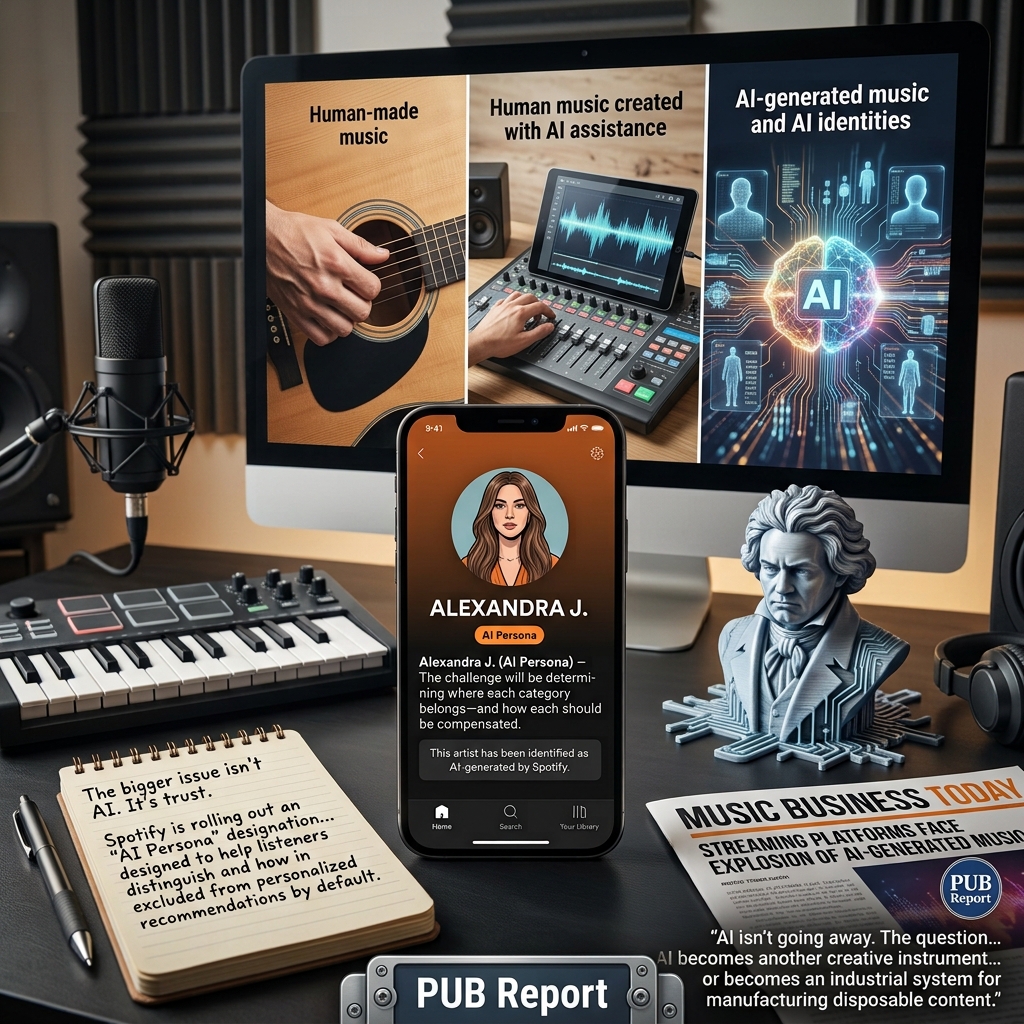
Beginning this month, Spotify is rolling out an “AI Persona” designation for artist identities that it determines are AI-generated. The label is designed to help listeners distinguish between human performers and artificial artist identities appearing on the platform. Spotify also says AI-generated personas will be excluded from personalized recommendations by default.
The move comes as streaming platforms face an explosion of AI-generated music.
Deezer reported that AI-generated tracks accounted for more than half of new daily uploads to its service in June, illustrating just how quickly synthetic music is entering the streaming ecosystem.
The bigger issue isn’t AI. It’s trust.
For years, streaming platforms have operated on a relatively simple premise: an artist profile represents a person, group or creative entity responsible for the music being presented.
Generative AI complicates that relationship.
A listener can now encounter an artist who appears to have a biography, artwork, social media presence and professional catalog—only to discover that the “artist” doesn’t actually exist in the traditional sense.
Spotify says its new system will combine artist disclosures with human review and AI-based investigative tools rather than relying entirely on artists to identify themselves.
For legitimate artists, that distinction could become increasingly important.
AI isn’t necessarily the enemy
There’s another side to this story.
Spotify itself has been moving toward licensed AI-assisted creation. In May, the company announced agreements with Universal Music Group and Universal Music Publishing Group that would allow participating artists and songwriters to authorize AI-generated covers and remixes, with compensation and credit built into the model.
That’s a very different proposition from an anonymous AI persona flooding a platform with thousands of tracks.
The emerging music economy may therefore develop into three broad categories:
- Human-made music
- Human music created with AI assistance
- AI-generated music and AI identities
The challenge will be determining where each category belongs—and how each should be compensated.
Independent artists have something to gain
For independent musicians, transparency could ultimately be beneficial.
If streaming services become better at identifying artificial streaming activity, fake artists and automated content farms could have a harder time competing for attention with musicians building actual careers.
But artists will also need to become more transparent about their own use of AI.
The industry is moving toward a world where how a song was made may become part of the metadata surrounding the song itself.
And that could change how audiences judge authenticity.
PUB Report Takeaway
AI isn’t going away.
The question for the music industry is whether AI becomes another creative instrument—like synthesizers, samplers and Auto-Tune—or becomes an industrial system for manufacturing disposable content.
The answer may depend less on the technology itself and more on whether platforms can create trust, transparency and fair compensation around it.
About The Author