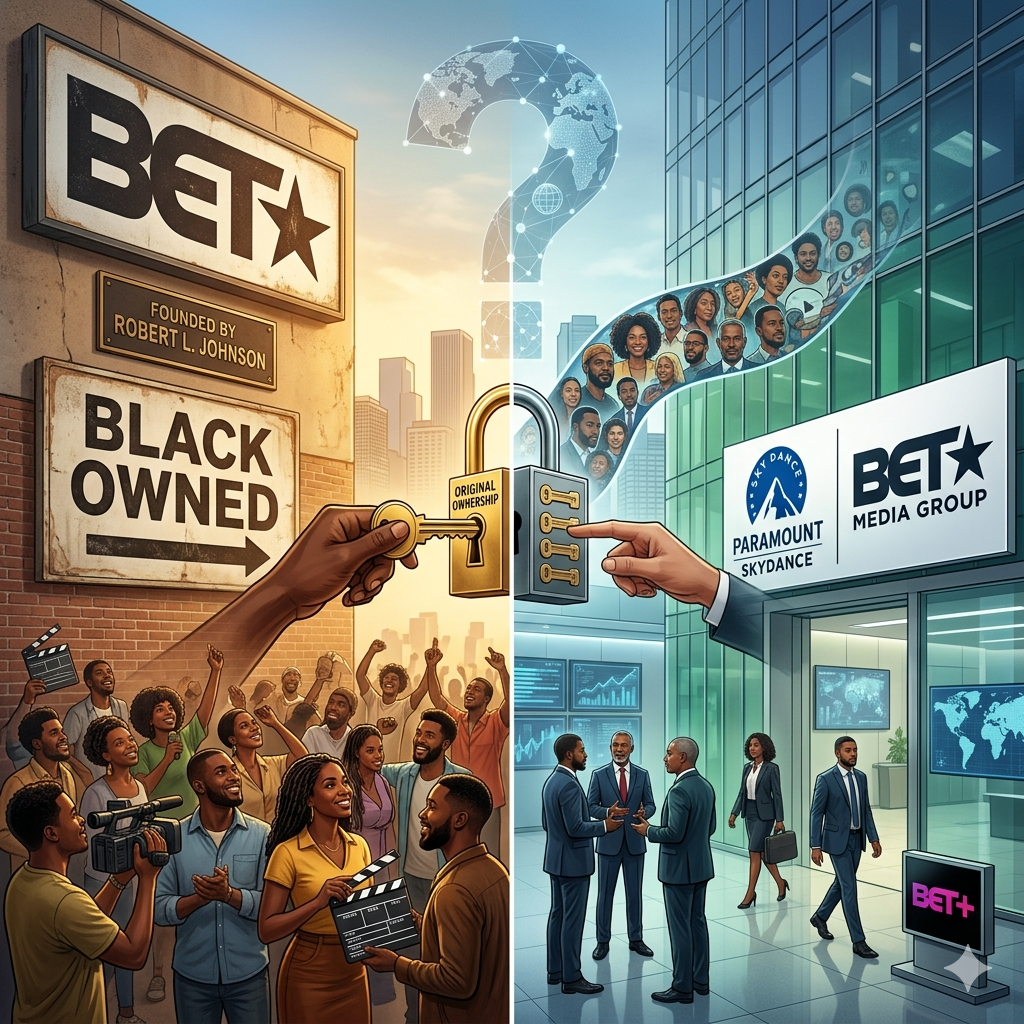
For decades, BET has stood as one of the most influential names in Black entertainment and culture. From groundbreaking music video countdowns and award shows to original programming centered around Black audiences, the network became a cultural institution. But in 2026, many viewers are asking an important question: Who actually owns BET today, and can it still be considered Black-owned?
BET was originally founded in 1980 by Robert L. Johnson and Sheila Johnson, making history as one of the first major Black-controlled television networks in America. The network eventually became the first Black-owned company listed on the New York Stock Exchange, symbolizing economic empowerment and representation within the media industry. However, that ownership changed in 2001 when media giant Viacom acquired BET in a multi-billion-dollar deal. Today, BET operates under Paramount Global through its BET Media Group division, meaning the network is no longer Black-owned in the traditional corporate sense.
The conversation around ownership resurfaced in recent years because of filmmaker and producer Tyler Perry, who acquired a minority stake in the streaming platform BET+ in 2019 as part of a production partnership with the company. For some, Perry’s involvement represented at least a partial return of Black ownership within the BET ecosystem. But in 2026, Paramount reportedly bought out Perry’s stake in BET+ while restructuring its streaming operations, effectively ending the last known Black equity ownership connected directly to the platform. Perry remains a major content producer and creative partner, but no longer has an ownership role in the streaming service.
Despite the corporate structure, BET continues to employ Black executives, producers, writers, and talent while maintaining programming aimed primarily at Black audiences. The network still produces award shows, documentaries, scripted series, and music programming that highlight Black culture and entertainment. However, critics argue that representation and ownership are not the same thing. While Black faces may remain visible on-screen and behind the scenes, the ultimate financial control and decision-making power belong to a larger multinational corporation.
That distinction is why this conversation continues to resonate across entertainment. Ownership determines who profits, who controls creative direction, and who builds long-term generational wealth from Black culture. The debate surrounding BET mirrors larger discussions happening across the music and film industries, where creators are increasingly fighting for ownership of their masters, publishing, content libraries, and distribution platforms.
Public reaction has been mixed. Some viewers feel BET lost its original identity years ago as corporate priorities shifted. Others believe the network still serves an important purpose by maintaining a major platform focused on Black entertainment in mainstream media. At the same time, many independent creators see this moment as motivation to build and control their own media platforms rather than relying on legacy corporations.
So, is BET still Black-owned? Technically, no. BET is owned by Paramount Global, not by Black ownership groups or founders. But culturally, the network still carries enormous significance within Black media history and entertainment. The bigger question now may not be about BET itself, but about whether the next generation of Black creators and entrepreneurs will build platforms they can fully own—and keep.